


Short & straight
If you want to ferment or preserve vegetables and fruit, you need jars that are food-safe, heat- and acid-resistant, airtight, and easy to clean.
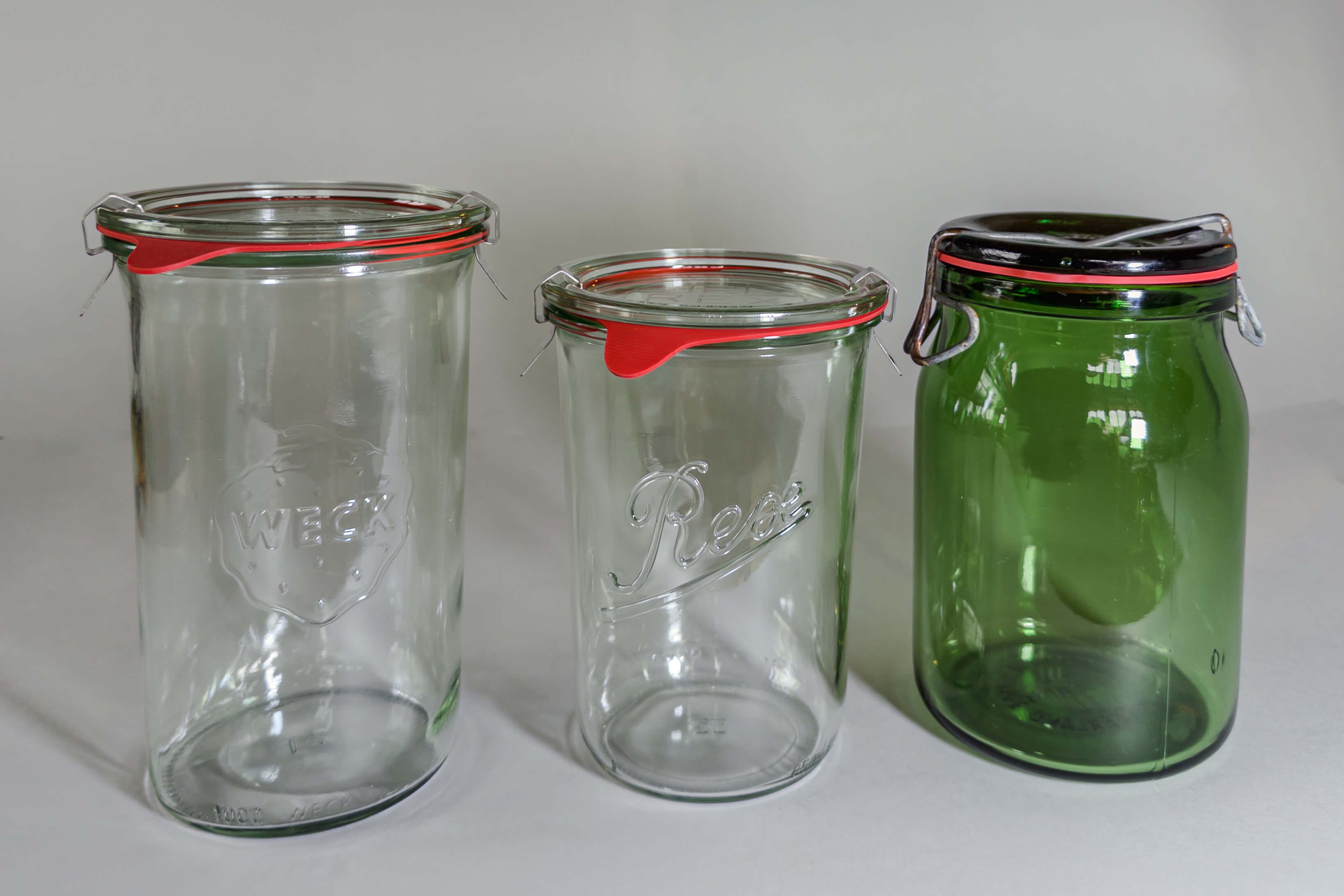
The Germans have their WECK jar, the Austrians their REX jar, and the Swiss their Buelach jar.
Behind those European preserving brands lies real history. To this day, Germans say “einwecken” (WECK) and Austrians say “einrexen” (REX).
For all their differences, the jars, rubber rings, glass lids, and metal clamps of all three systems are compatible with each other. (Europeans do not use screw-top jars for fermenting and preserving.)
On my kitchen table sit three preserving jars like contestants at a casting show: a WECK jar, a REX jar, and a Buelach jar. All of them wear bright orange rubber seals and shiny metal clamps. All of them claim to be “the original.”
And there I stand — a man who’s spent years writing about food systems — now about to trip over a piece of glass.
I don’t want anything heroic. I just want to ferment vegetables and fruit in a jar that goes Pffft when I open it — not Yuck. I want a jar that seals tight without blowing up in my face. A jar I don’t have to scrub clean while muttering a thousand new curse words.
My head says: “You’re on Team Science. There are criteria.” My gut says: “Pick the prettiest jar.”
And somewhere between those two voices sits the sober question that pulls my grand fermenting ambitions back down to earth:
Which jar is actually ideal for fermenting — and why?
How to receive only the English-language newsletter.
Here, I’ll show you — plain and simple.
So begins my field experiment: Which jar works best — and why?
Why on earth does every country have its own preserving jar?
Canada: Bernardin (screw-top system)
France: Le Parfait (not to be confused with the spread of the same name)
Italy: Quattro Stagioni (screw-top system)
Germany: WECK
Austria: REX
Switzerland: Buelach jar — now mostly found in museums
To answer the question of national peculiarities in Germany, Austria, and Switzerland, we travel back 130 years.
The critical point of the preserving jar: the round rim
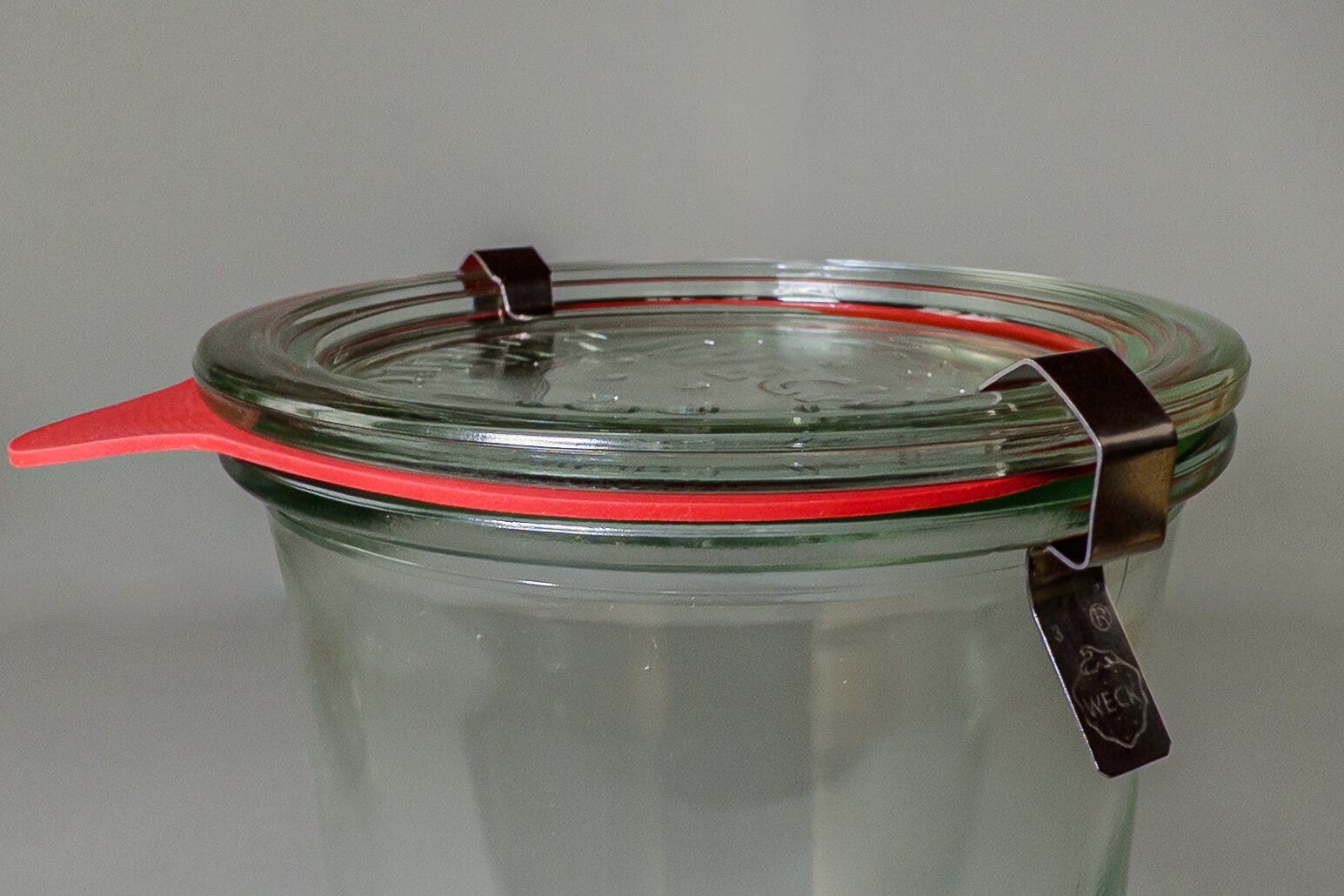
Unlike the preserving jars in the USA and Canada, which have screw threads and tin lids, European preserving jars have a smooth round rim with a glass lid, sealed by an orange rubber ring and held in place by metal clamps.
That round rim with rubber ring is the sealing surface. The glass base meets the glass lid evenly. Unlike screw-thread jam jars, the round rim provides a smooth, uniform surface where the rubber ring can sit tight. No little nicks. No sealing drama.
German, Austrian, and Swiss jars differ in branding — but their sizes are standardized. RR60, RR80, RR100. “RR” stands for round rim. Now, the local jokers liked to claim the “RR” really stands for Rolls-Royce — on account of those jars costin’ about as much as a luxury sedan. And depending on how many of them a housewife bought, this joke quickly ceased to be funny.
The number 60, 80, 100 marks the diameter in millimeters. If the number matches, the accessories fit.
The metal clamps press the glass lid down over the rubber ring onto the rim. The round rim distributes the pressure evenly so the lid stays stable without tilting or scratching.
In Germany, people “weck” their food
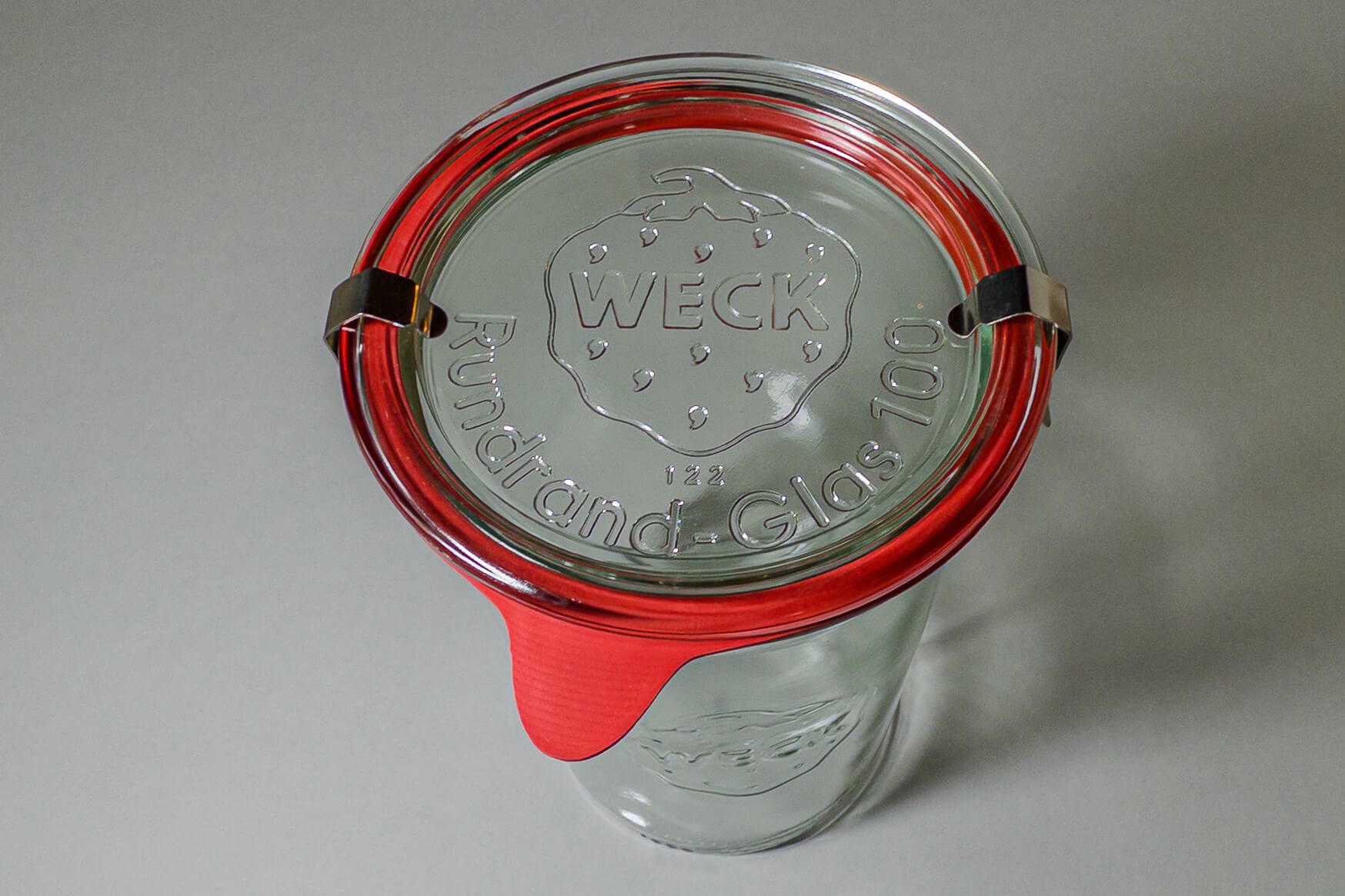
The name WECK jar is a bit misleading. The principle was invented by chemist Rudolf Rempel, not Johann Carl Weck. The vegetarian and anti-alcohol activist Weck bought a whole railroad wagon of jars from Rempel — and in 1895 also bought the patent. He had the jars produced under his name in several glassworks in Germany and in what is now Poland.
Weck himself left the company not long after it was founded, and Georg van Eyck stepped in to take over WECK. About fifty years before anybody ever heard of a Tupperware party, van Eyck was already sendin’ his own “WECK home economists” all across Germany — touring cooking schools, hospitals, and parish houses to show folks how the WECK system worked. Less advertising, more good old-fashioned kitchen demonstrations.
The WECK jar became so popular that the verb “einwecken” entered the German dictionary in 1934.
For decades, WECK dominated the German market. The company even built its own publishing house, producing household guides and a monthly magazine called “Ratgeber Frau und Familie” (“Guidebook for Women and Families”), printed in several hundred thousand copies.
After World War II, the company lost its glassworks in East Germany and what is now Poland. A new glass plant was built in Bonn-Duisdorf in western Germany.
Today, WECK produces around 1 million jars a year at its Bonn-Duisdorf glassworks
For decades, business was steady. After the canning boom during the pandemic cooled off and energy prices for glass production soared, the historic company filed for insolvency in 2023.
The Munich-based Aurelius Group acquired WECK and consolidated production in Bonn-Duisdorf. Before that, millions of jars had been hauled over 300 miles south to Wehr-Öflingen — just three miles from the Swiss border — for packaging.
Today, according to the company’s own figures, the Bonn-Duisdorf plant — with around 300 employees — produces roughly 500 million glass containers a year for markets in Germany, Switzerland, and beyond. Not just WECK preserving jars, but also beverage bottles and jars for honey, pickles, and the like.
Since the takeover, about 30 million euros have been invested up to 2026 to keep the company growing — proof that even in the modern world, there’s still plenty of business in a good sturdy jar.
In Austria, people “rex” their food
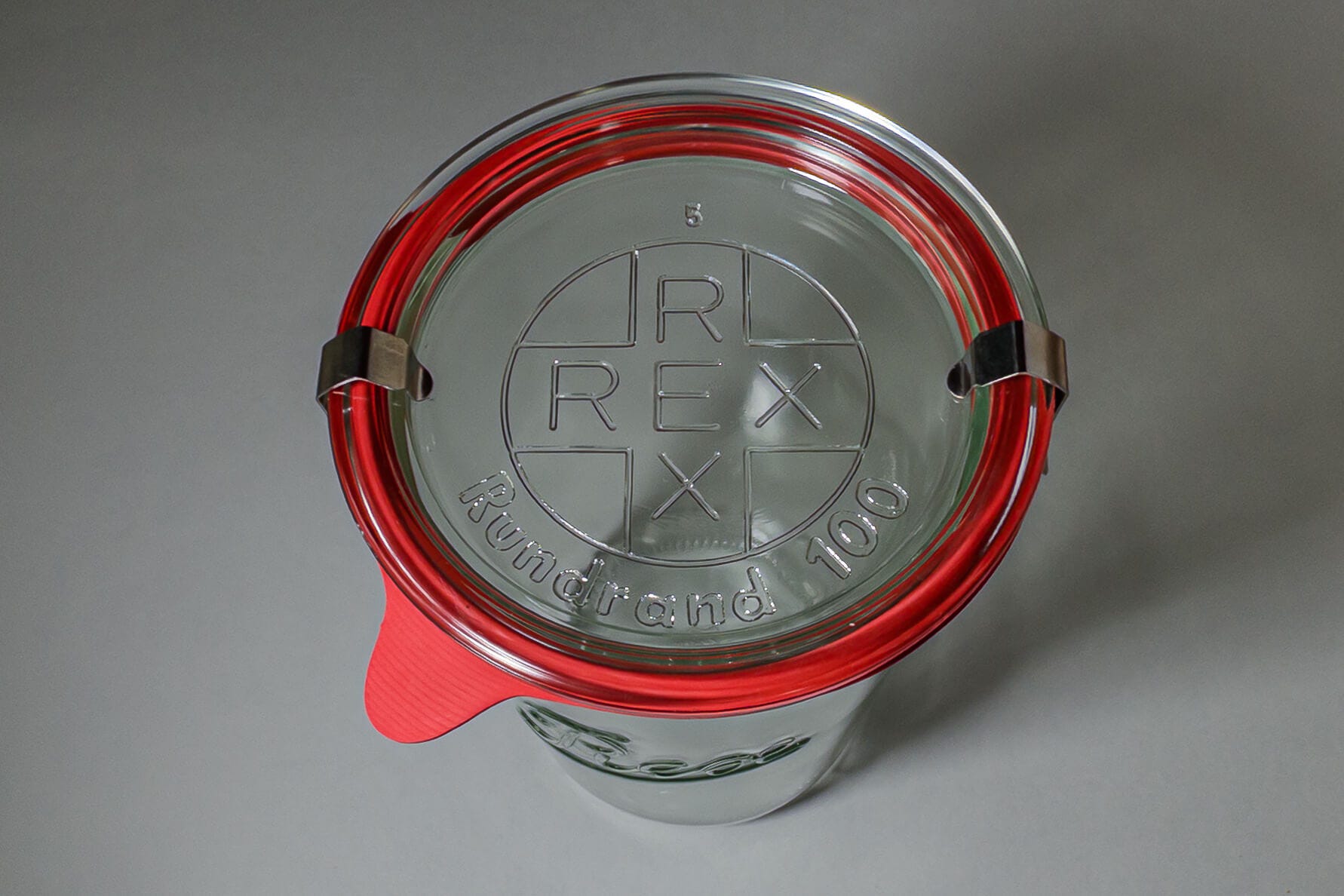
A few years after WECK, Jean Emil Leonhardt and Friedrich Kleemann founded the REX preserving jar company in 1908 in Bad Homburg, Germany. In 1926, Kleemann’s son discontinued jar production and sold the brand rights.
Instead, the young Kleemann built the legendary Horex motorcycles. The name combined “Homburg” and “REX.”
The rights and patent for the REX jar were sold to WECK, which then produced REX jars in its own glassworks after 1926.
In Austria, REX jars were placed in retail stores by exclusive distributors for decades.
And what sits long enough on a shelf settles into people’s minds. My Austrian grandma used to say in the 1960s while preserving: “Listen close, boy — we’ve always rex’d our vegetables and fruit. And that’s that.”
There’s psychology at work. Once you’ve stocked your cupboard with REX jars, rubber rings, lids, and clamps, you don’t switch brands lightly.
Technically, REX and WECK jars are compatible. Same round rim size, same accessories. The visible difference is only the name embossed in the glass.
Today, REX produces about 100,000 jars a year in a European glass factory
WECK stopped producing REX jars in 1982. But a brand name can sleep — and still live on in language. In Austria, “einrexen” outlasted every jar.
That’s why in 2015 Müller Glas & Co in Austria revived the REX brand. One year later, REX jars reappeared with a retro design and updated assortment — and returned to Austrian kitchen cabinets.
Today, according to industry sources, around 100,000 REX jars are produced annually in a European glassworks for Austria and Switzerland. Müller Glas & Co employs about 100 people and has annual revenues around 50 million euros, though only a small portion comes from REX jars.
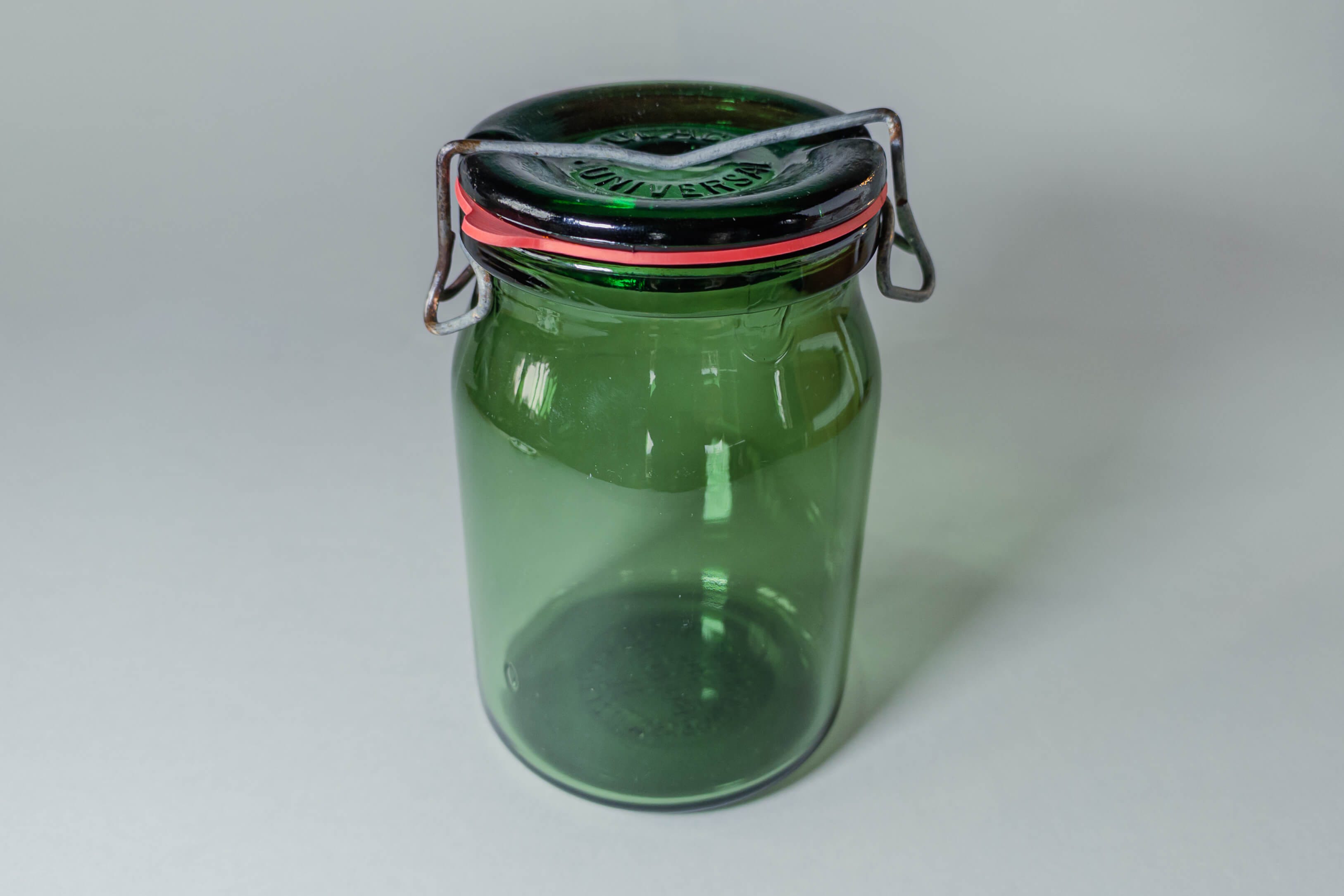
In Switzerland, people “preserved” their food with Buelach
Back to World War I. Switzerland was spared direct fighting but suffered supply shortages and inflation. Backyards, parks, and sports fields were turned into vegetable gardens. The harvest needed preserving.
“In Switzerland, ‘preserving’ didn’t mean sterilizing like in Germany and Austria,” explained Renate Menzi, long-time curator at the Museum of Design in Zurich. “It meant hot-filling — less effort, but absolute cleanliness required.”
German WECK jars became scarce. So the Swiss government commissioned the Buelach glassworks near Zurich to produce a domestic “cooking bottle.” (Buelach in Swiss German: Bülach, pronounced roughly “BEW-lakh”)
The first Buelach jar was introduced in 1920. Like a swing-top beer bottle, it had a white porcelain cap and sealed with an orange rubber ring.
The glass was thicker than WECK and REX jars and tinted the characteristic dark “Buelach green” due to iron-rich quartz sand. That color gave brand identity — and protected contents from sunlight.
With its fixed lid and narrow 1.5-inch opening, the early Buelach jar was more bottle than jar — and rather tricky to fill and clean.
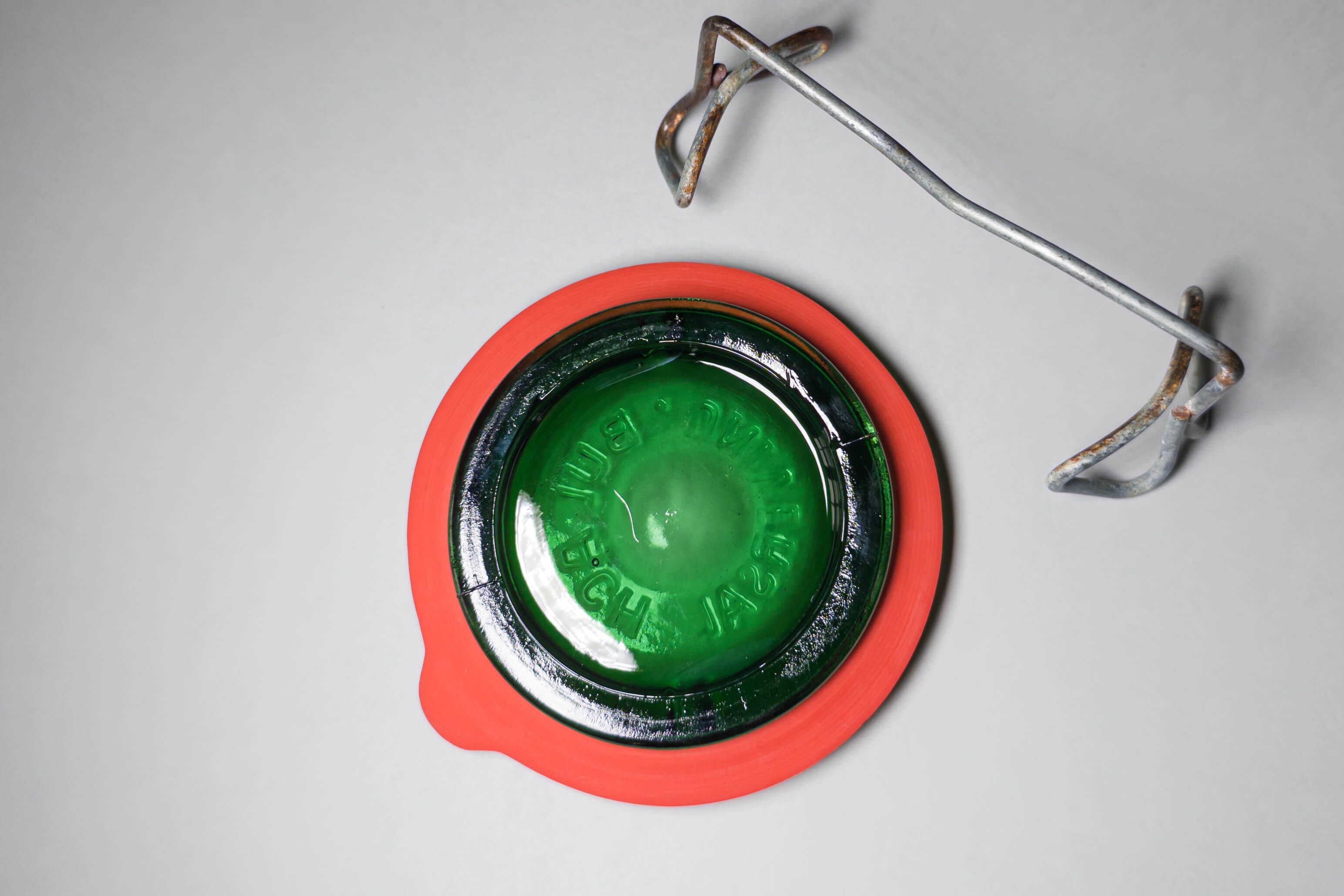
From 1924 onward, Buelach introduced a cast-glass lid with matching rubber seal and removable wire clamp. The wire fit into a groove in the lid and latched onto the neck.
In 1944 alone, 2.5 million Buelach jars rolled off the line
The green preserving bottle became a national brand in Switzerland, supported by posters, recipe booklets, and public demonstrations.
In 1939, a version with a wider 2.5-inch opening was introduced for whole fruit. Later, in 1948, the “Universal” Buelach jar with an even wider opening came to market, and from 1952 onward it featured a patented swing clamp.
Buelach jars were produced until 1972. Then freezers replaced pantry shelves. The Buelach glassworks itself closed in 2002. (Link to a TV report by Swiss television)
The Buelach jars I use for my fermentation experiments are, quite literally, museum pieces — complete with patina.
So which jar wins?
After this casting show of glass systems and long conversations with neighborhood grandmothers, I’ve realized something:
The “ideal preserving jar” isn’t about brand. It’s a character test. Not for the jar — for me.
Every system works if I follow the rules:
Work clean. Keep everything under the brine. Don’t open the jar every five minutes like a jittery stockbroker checking his phone during a fermentation panic.
So I’ll spend a year practicing patience.
My goal: a Christmas meal with vegetables and fruit fermented in all three systems — WECK, REX, and Buelach.
And here’s what I already know from my first trials:
The best part of fermenting isn’t filling the jar. It’s that quiet hiss when I open it — Pffft — like the jar itself is whispering: “See? You just gotta stop fussin’ over me and let the microbes do their work.”
All clear? Y’all agree, or you see it a little different? Drop your thoughts down below in the comments.
How to receive only the English-language newsletter.
Here, I’ll show you — plain and simple.
Full overview of the entire fermentation series: all articles on one page
